Vivian Hamilton MAISEY
Serial Number: NZ
RNZAF Trade: Pilot
Date of Enlistment: 3rd of September 1939 (Army)
Rank Achieved: Lieutenant in Army, Flying Officer in RNZAF, Sub-Lieutenant in Royal Navy Fleet Air Arm
Flying Hours:
Operational Sorties:
Date of Birth: 21st of June 1921
Personal Details: Vivian was the son of Charles Henry Maisey and Irene Maisey. Charles had been the constable in Cambridge for many years before being transferred during the war to Epsom. Vivian was married in 1951 to Annette Henry, and they had two sons, Christopher Harry Maisey and John Reginald Maisey.Service Details: Vivian was in the Territorial Army before the war in the Waikato, and was mobilised at the beginning of the war into the regular New Zealand Army. He trained initially at Papakura Camp in south Auckland and was among those training for the 4th Reinforcements and was all ready to go overseas when it was discovered by the authorities that he was in fact too young to do so. With the prospect of not getting overseas with the army at that time, he looked at his options and decided to apply for the RNZAF, who allowed overseas service at a younger age.
By the time he was transferred across to the RNZAF in 1943 he was a Lieutenant in the Army, and so dropped in rank for his flying training. His initial posting for pre-entry training as aircrew was on the 19th of June 1943 to No. 305 Squadron RNZAF, an Aerodrome Defence Unit based at RNZAF Station Masterton.
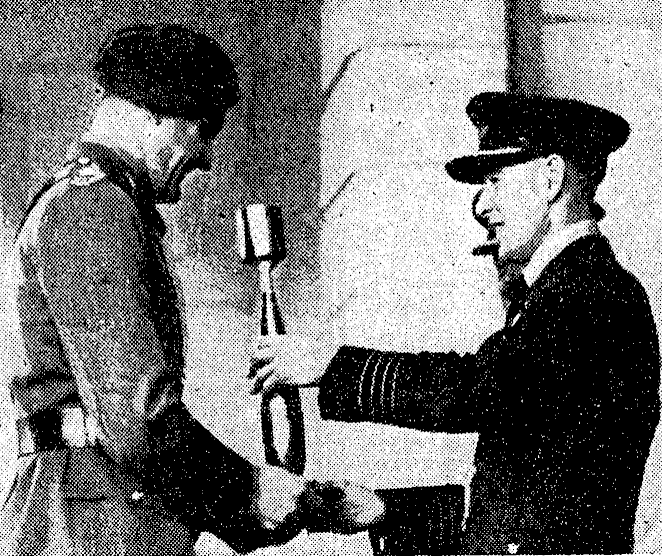
Vivian completed his flying training at RNZAF Station Wigram, most likely on Airspeed Oxfords. His course had their passing out parade on the 11th of May 1944, and a photo of him appeared in the Press newspaper the following day showing him being presented a trophy by Group Captain J.H. Hill for best high-level bombing. The caption states that Vivian set "a new station record for high-level bombing among trainees at Wigram recently".
Above: The photo form the Press newspaper dated 12th of May 1944 where Vivian is
presented the trophy for high-level bombing by Group Captain Hill. Army officers retained
their uniforms through their flying training in case they did not complete the course and
had to return to the Army. Vivian passed so will have been kittred out in RNZAF blue
uniform soon after this photo.Vivian left New Zealand for Britain with the RNZAF in late May or June 1944.
Later while in Britain, because the RAF had too many pilots and the Fleet Air Arm was expanding its numbers, Vivian was transferred into the Fleet Air Arm. He remained in the Fleet Air Arm following the end of the war
Vivian was involved in a few incidents in aircraft. Whilst with No. 790 Naval Air Squadron, on the 23rd of October 1948, after landing a de Havilland Mosquito TR33 (Serial No. TW246) at NAS Culdrose, Cornwall, he accidentally selected the undercarriage handle to up instead of the flaps, the result being the wheels went up and the Mosquito collapsed onto the tarmac.
He was later posted to No. 792 Naval Air Squadron. On the 9th of March 1949 he was piloting a Fairey Firefly FR1 (Serial No. PP456) and was landing at Culdrose when his aircraft struck trees during the approach to the runway. There was luckily no damage or injuries and he made it down safely.
The third incident was on the 19th of July 1949 in another No. 792 NAS Firefly FR1 (Serial No. PP599) he was forced to make an emergency landing when the engine began to run roughly, but again no damage or injuries.
Then on the 19th of September 1949, Vivian's luck ran out. he was flying Fairey Firefly FR1 (serial number PP561) of No. 792 NAS, from Culdrose. The aircraft suffered an engine failure and Vivian brought it down into the English Channel, five miles off Penzer Point, near Mousehole, Cornwall. In the impact with the water Vivian suffered a broken back but was rescued. Due to the injury he was eventually invalided out of the Navy and returned home to New Zealand and civilian life.
Details of Death: 7th of April 1973, at Auckland, aged 51
Interred at: Vivian's ashes were scattered at Waipu Cove, his favourite fishing spotConnection with Cambridge: Vivian lived in Cambridge before the war and joined up from here
Waikato Independent newspaper reports mentioning Vivian Maisey:
Infantry 4th Reins for Papakura 6 Sept 1940
To Camp 30 Sept 1940
Farewelled with wallet 24 May 1944Additional Information: From the Evening Post newspaper dated 22 February 1945, via Papers Past, article 'In All Three Arms' on page 7
- Also 1948 and 1949 crash details from Air Britain's "Fleet Air Arm Fixed-Wing Aircraft Since 1946", via Laurie BeanThanks to: Mrs Annette Maisey, Vivian's widow, who has helped to fill some gaps on this page.
| Home | Airmen | Roll of Honour |
|---|