The Air Training Corps in Cambridge
In the closing months of 1942, Cambridge became home to a new Air Force-related organisation with the establishment of a Cambridge Flight of the Air Training Corps. The Air Training Corps, or ATC, was a cadet corps that began in 1941, which was much like the boy scouts, but with a definite theme of military aviation.
The ATC was of prime importance back in 1942, because its teenaged members learned many subjects in their training that would allow them easy access into the RNZAF as aircrew, and therefore it took some of the burden off the RNZAF training schools. As the saying goes, forewarned is forearmed. There was a lot of publicity about for the ATC that attempted to drum up members, and the boys obviously flocked to join because it was seen as a stepping stone into the RNZAF. Every boy in the 1940's dreamed of flying Spitfires and Kittyhawks and Corsairs, and the ATC might just have set them on the path to do just that. The ATC also ran the entry exams for the RNZAF.
Sadly my research has turned up few facts so far regarding the Cambridge ATC Flight, which is long since defunct nowadays - despite its Hamilton HQ squadron still thriving strongly. The reason little information can be found is because it was established just before 1943, and no Waikato Independent newspapers from that year have survived in the Cambridge Museum's collection due to the volume being lost in a fire while they were still owned by the Independent itself.
However, I am reprinting below any related articles from the newspaper about the ATC Flight that I come across. All related articles I have so far discovered are below. Also I have added a few pieces of related publicity material from the time. The first few articles are not directly related to Cambridge, but their printing in our Waikato Independent paper probably helped spur on the setting up of our own unit here in Cambridge. Also of this page I plan to add a roll of members - again difficult as no list has been discovered yet in my research. This will hopefully grow as research progresses.
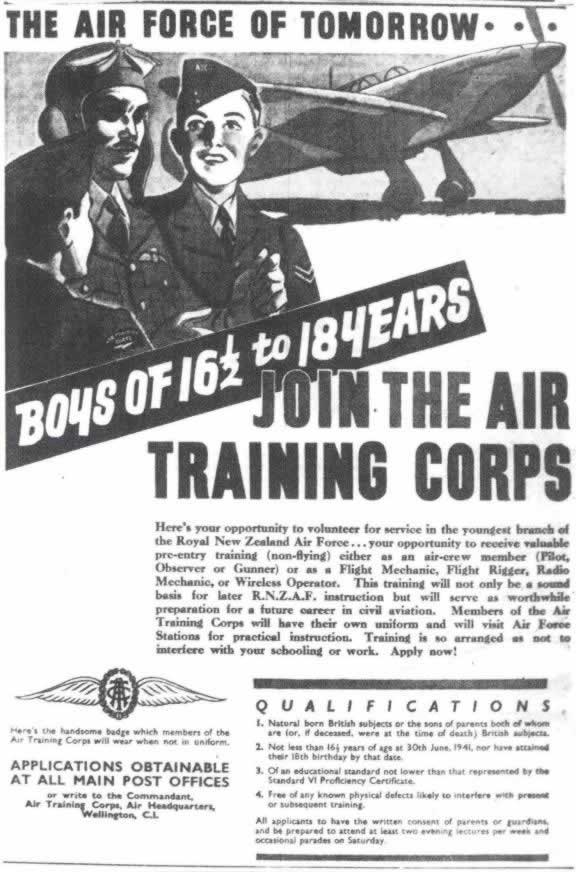
What is known is that No. 7 (Hamilton) Squadron ATC formed in September 1941, and at that time Flight Lieutenant C.C.N. Johnston and Flying Officer H.A.C. Davy were in the Waikato from Air Headquarters in Wellington to assist in establishing the unit. The two officers visited Cambridge on a recruiting drive to get Cambridge boys to join. At that stage the Cambridge members would have to travel to Hamilton for parades, it would not be till 1942 that a Cambridge Flight of the Squadron was formed. They were to arrange for the Cambridge boys to be transported to the parades which would take place one night per week. Applicants had to be aged between 16½ and 18 years old with a Standard 6 Proficiency Certificate and written permission from their parents to join.
Air Training CorpsOrganisers:
• Frank Green (1942-43)
• J.H. Yoland (1942-43)
• Bill Allen (1944-45)
Cadets:
• Graham Kelly
• Robert Bugden 'Bob' Peake
• ?? Ray
• Maurice Alan Walker
• Robert Gray 'Bob' Wright
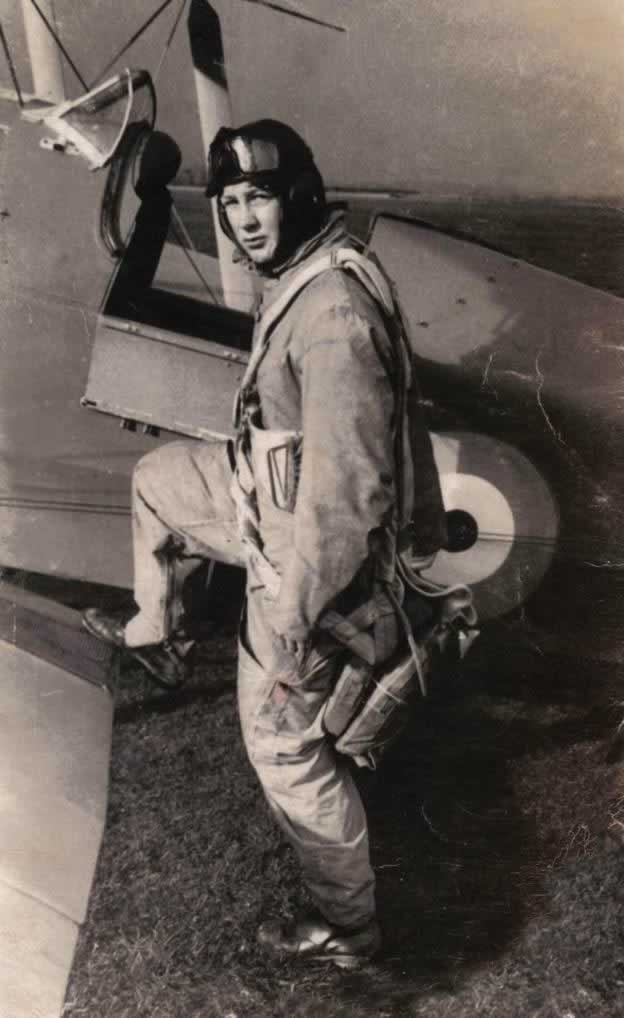
Cambridge Air Training Corps cadet Maurice Walker looks full of trepidation as he steps onto the wing of a de Havilland DH82a Tiger Moth for what was very probably his first ever flight
Air Training Corps Units outside of Cambridge
No 7 (Hamilton) Squadron, Hamilton
• Leslie Buttimore - 1941
• Bryan Cox - 1941 till 1943 (ex-Cambridge)
• Ross Cuthbert - 1942
• Gordon Henderson - 1941 till 1942
• Albert Laurent - 1941 till 1943
• John Richardson - 1941 till 1943
No. ? Squadron, Te Awamutu
____________________________________________________________________
Waikato Independent
11th of September 1942Air Cadets Training
Cadets of the Air Training Corps are now gaining actual experience of the duties they will perform when they enter the Royal New Zealand Air Force. During the school vacation a number of picked cadets did both skilled and unskilled work at a South Island station. They worked with flight mechanics, radio maintenance men, and aircrew trainees, and did everything from washing down aircraft to co-operating in advanced training.
Waikato Independent
6th of November 1942
Air Training CorpsAir Training Corps – After many difficulties had continually hampered plans, the first parade of the new Te Awamutu flight of the Air Training Corps was held this week. The attendance was good, 44 youths being there to receive instructions regarding future training arrangements. The service night has been fixed for each Monday.
Waikato Independent
18th of November 1942YOUNG AIRMEN
Flight For Cambridge
Considerable Interest
On Monday evening last Squadron Leader P.M. Fowler, of Auckland, and Flying Officer S. Cuthbertson, of Hamilton, visited Cambridge, and at a meeting held in the Council Chambers it was unanimously decided to form a flight in Cambridge of the Air Training Corps. The Deputy Mayor (Mr A.H. Nicoll) presided, and there was a good attendance of boys interested in the movement.
The purpose of the movement was explained at length by Squadron Leader Fowler, who is O.C. for the Auckland wing, while Flying Officer Cuthbertson is O.C. No. 7 Squadron, Hamilton.
Fine Job of Work
The Squadron Leader said today almost all boys are air-minded, and the purpose of the Air Training Corps is to develop that comparatively new sense among the youth. He said the movement had started in the Old Country, and had now spread throughout the Empire. It was doing a fine job of work in laying the foundation for the provision of future air crews.
If a flight was formed in Cambridge, said the Squadron Leader, it would be called a detached flight, and it would be attached to No 7 Squadron (Hamilton Headquarters). There were flights in Hamilton and in Te Awamutu and Morrinsville. Already a number had been sent onto the Air Force for further training. It required 30 lads to make a flight possible in Cambridge.
Cambridge Airmen
Squadron Leader said he was pleased to see the interest in Cambridge, and, as Mr Nicoll had said, Cambridge had acquired the knack of producing good airmen. He assure Mr Nicoll he was well aware of such Cambridge airmen as Wells, Calvert, and Law. The Empire was looking to its younger generation, and boys wanted were from 15 to 18 years of age. In the production of qualified airmen the A.T.C. figures were already high. It was a purely organising body, and the boys joining had to have the consent of their parents.
The Squadron Leader said most of the lads joining up wanted to be pilots, but he assured those present that the prospects of a pilot, especially in peace times were not nearly as attractive as those for a navigator or even a first-class mechanic.
There were good opportunities in the Air Force for navigators, mechanics, flight riggers, armourers and office side.
By taking on this side of aviation they were assured of a trade as a background for them. The boys in the A.T.C. had to pass a pre-entry examination before they were 18 years of age. They had to get 80 per cent. marks or better, and such passes enabled a lad to go past a lot of elementary training at the Air Force schools.
Boys had to be good at games, and in the A.T.C. all forms of games to improve health and body physique were encouraged to the highest extent.
Must Be Tryers
The Squadron Leader impressed on the lads present that it was no good them joining up unless they were keenly interested, were prepared to attend parades regularly, and above all, good disciplinarians. Lads who were not tryers in the A.T.C. had no hope of getting into the Air Force through the “back door”. If a flight were formed in Cambridge the boys would be required to parade two nights at least. The athletic side was most important. After passing out of the A.T.C. and going into the force, the first thing a young man was asked for was his athletic record. The educational side was also most important.
Flying Officer Cuthbertson said if Cambridge formed a flight, all the training that was offered the Hamilton flights would be available to the Cambridge flight. This would mean a little transport organizing in Cambridge to get the lads to the nearest ‘drome. An A.T.C. correspondence course was available to any members who could not get to town parades. Squadron Leader Fowler said he would like to see 12 Cambridge boys, who were at present attached to the Hamilton Squadron, join and form the basis of the Cambridge flight.
Flying Officer Cuthbertson said he would be sorry to lose the Cambridge lads, but he agreed that it was right for them to join the Cambridge flight.
Both officers were accorded votes of thanks for coming to Cambridge, after which a number of lads enrolled, and as soon as 30 join up and a medical test passes 25 of them a flight will be formed.
Mr F.H. Green was appointed acting flight-commander, and Mr J.H. Yoland as educational officer. With a view to encouraging interest in the movement and to provide some funds, a recruiting dance will be held in the Town Hall on the 26th inst. Enrolment forms may be obtained from Messrs F.H. Green and J.H. Yoland
Waikato Independent 25 November 1942
CAMBRIDGE A.T.C.
RECRUITING DANCE
WING-COMMANDER WELLS'
GOOD WISHES"Thanks for your invitation; regret duties prevent visit next week; hope see Cambridge A.T.C. future date. Congratulations to all concerned and best wishes for successful A.T.C. flight in Cambridge. Can not emphasise too strongly importance and value A.T.C. training." - Bill Wells.
This was the reply Mr F.H. Green, acting commander of the newly formed Cambridge Flight of the Air Training Corps, received from the wing-commander when he was invited to attend the big recruiting dance to be held in the Town Hall to-morrow (Thursday) night.
Keen interest is being shown in the formation of a Cambridge flight, and the dance to be held to-morrow night is for the purpose of raising funds to enable the flight to carry on its work.
Waikato Independent
25 November 1942AIR TRAINING CORPS
The Royal Air Force early recognised that if its full war effort was to be increased, or at least maintained, it was necessary to look to the younger generation for reinforcements. Youth certainly predominates in this arm of the nation's services. So there came into being the Air Training Corps.
The movement, naturally, spread to Canada and America, and now it is well on its way in this country. It has been established in new Zealand for over 12 months, and during that time many age-qualifying youths have passed out of the corps to take up more advanced training in the R.N.Z.A.F.
Already there are five flights in the Waikato, including Hamilton, Te Awamutu, and Morrinsville, and the establishment of a flight in Cambridge is practically established.
Who commend the local effort and those persons who are fostering it. Most all boys are air-minded to-day, and New Zealand can be justly proud of the record of its airmen to date.
As we have previously published the local corps needs the nominations of good healthy lads, but it is absolutely essential that lads nominating should have the consent of their parents. Squadron Leader P.M. Fowler also made it quite plain, when in Cambridge recently, that only lads who are real tryers are wanted in the corps.
Here is a great opportunity for some of our Cambridge lads, and even, if eventually they are not successful in getting into the Air Force, then the period of healthy training and their submission to good but rigid discipline will be to their lasting benefit.
As we publish elsewhere in this issue the local flight organisers are holding a recruiting dance in the Town Hall on Thursday night and here's a chance for all interested to give their practical support.
.
Waikato Independent
27 November 1942A.T.C. Dance
The Air Training Corps dance, held in the Town Hall last night, was a great success, and the Cambridge Flight should benefit considerably. During the evening the acting-commander (Mr F.H. Green) spoke on recruiting for the Cambridge Flight, and thanked all who had assisted with the dance
Waikato Independent
11 December 1942Public Notices
AIR TRAINING CORPS
A PARADE of A.T.C. will be held on SUNDAY NEXT, 13th DECEMBER, at 10a.m. at the Town Hall. All intending members are asked to parade with cards completed.
F.H GREEN
Waikato Independent
31st of January 1944CONGRATULATIONS
TO LOCAL AIR CORPS
"ONE OF THE BEST UNITS"
Mr J.H. Yoland, officer in charge of the local Air Training Corps, has received a congratulatory letter from Squadron-Leader P.K. Fowler, C.O., of the Auckland Wing of the Air Training Corps.
In his letter he praises the members of the Cambridge School Unit who attended the recent camp at Palmerston North from January 4 to 10.
The Squadron-Leader said: "it was one of the best units on parade." The competitions were for discipline, steadiness, efficiency and cleanliness of huts.
Waikato Independent
24 July 1944Air Training Corps Dance
A reminder is given of the local A.T.C. dance to be held in the town hall on Wednesday evening. A feature will be dance music supplied by a RNZAF dance band. The members of the band coming to Cambridge are as follows: Cpl E. Crowder, drums and vocal (in charge); Cpl Stoodley, piano; LAC R. Lewis, trumpet; LAC R. Jones, 1st saxophone; LAC T. Large, 3rd saxophone; AC1 W. Russell, tenor saxophone. It is hoped that the dance will be well supported for the local squadron has been a valuable unit so far.
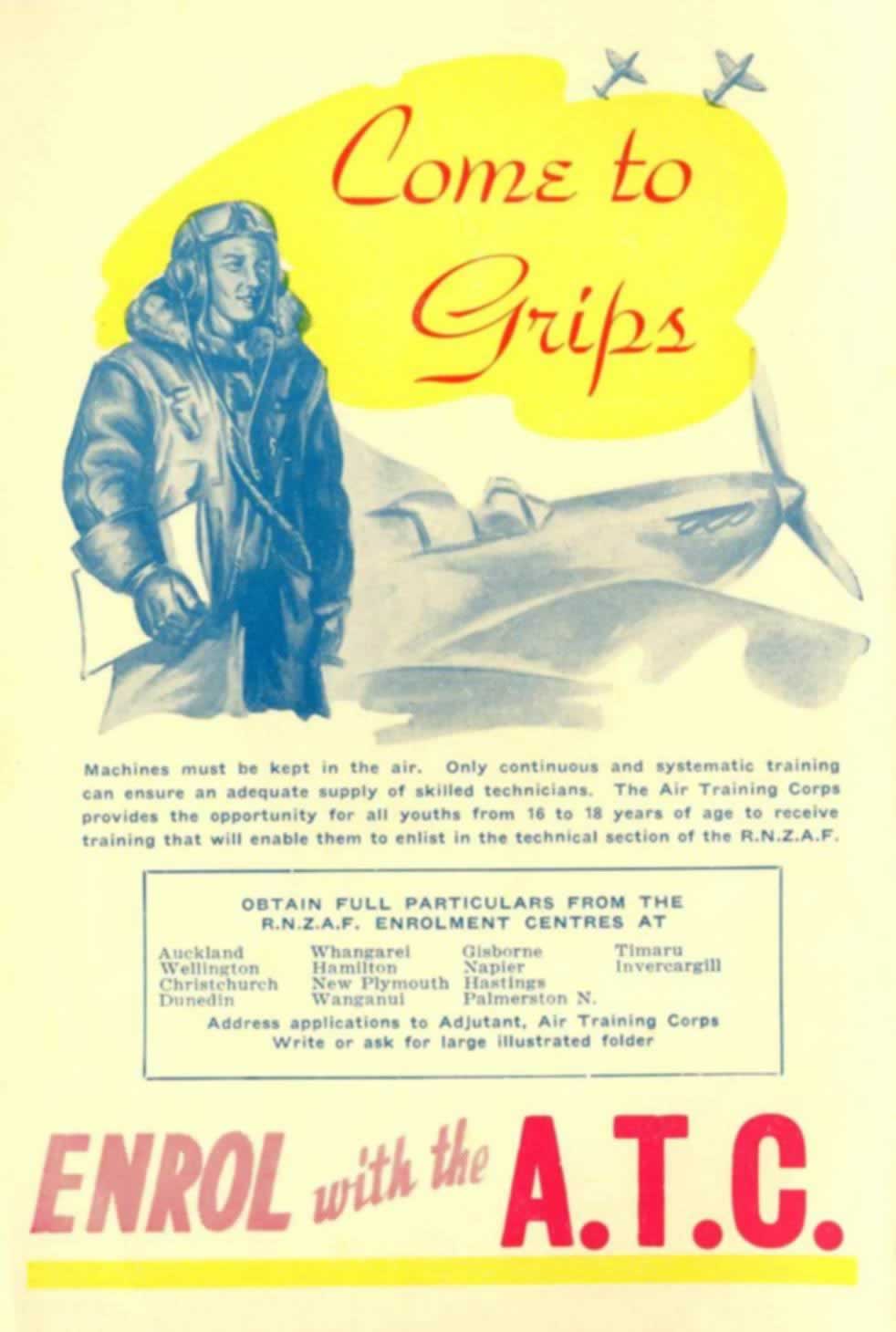
Above: A recruiting advertisement for the Air Training Corps that appeared in the January-February 1943 issue of Contact magazine.
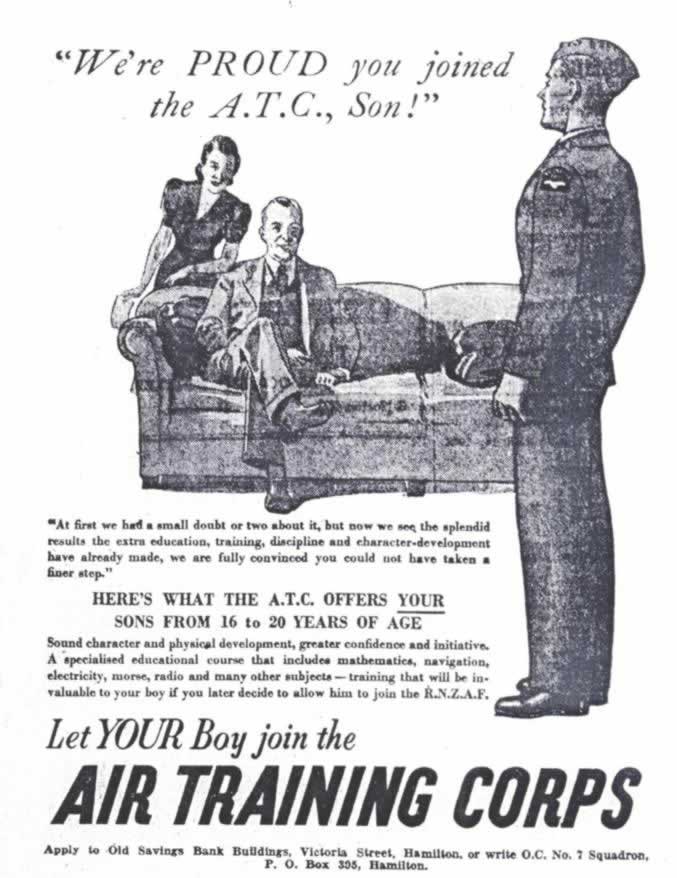
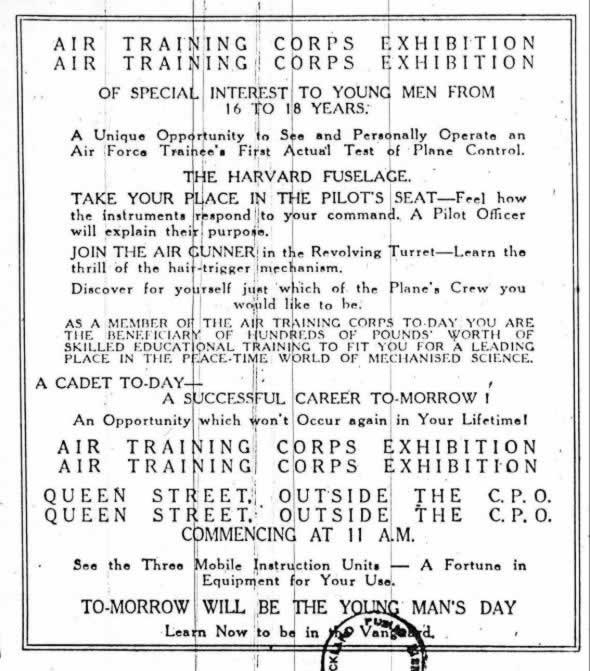
Below: An advertisement from a 1943 issue of the Waikato Times newspaper that asserts the ATC will make parents proud
Cambridge ATC, please email me

The New Zealand Air Training Corps
In Wartime
By Dave Homewood with Rod Mackenzie
The following are some very interesting facts about the Air Training Corps in New Zealand during the Second World War.
Air Training Corp squadrons first began to form across New Zealand from around June 1941 onwards. There were four different styles of unit - town units, school units, district flights/detachments (usually afilliated with a town unit) and correspondence classes.
The ATC was set up with the specific purpose of preparing boys aged between 16 and 20 years old (though the age range did vary over throughout the war) for future service in the Royal New Zealand Air Force.Run along similar lines to Boy Scouts and School Cadets, the ATC would teach the boys discipline, drill, the basics of aeronautics and the mechanical side of aviation, and many varied other skills that would later be applied in the Air Force.
By 1941 many boys were extremely keen on aviation, which was beginning to boom in New Zealand, and also keen to do their bit. Thousands of boys wanted to join the Air Force when they were old enough and the ATC was seen as an exciting stepping stone into the RNZAF.
By May 1942 sufficient numbers of ATC cadets had been trained up to the required skill level where the Royal New Zealand Air Force conducted its first specific intake of ex-ATC cadets. The first ATC cadets entered the RNZAF on the 30th & 31st May 1942 at RNZAF Station Levin. This included ex-cadets from around the country.
The next batch entered at RNZAF Station Taieri on the 9th, 11th & 29th July 1942. Thereafter, batches were received at RNZAF Station Levin, Taieri, Seagrove and even one cadet at Linton, up until the end of 1942. Then f rom the 8th January 1943 all ATC cadets enlisted at RNZAF Station Omaka, near Blenheim, irrespective of where they enlisted.
There the intention was that they would be 'fast-tracked' through the intitial training (so they did not repeat the training they received in the ATC). In practice, delays in the training process meant that the ATC cadets did invariably repeat the training, much to their dissatisfaction!
In 1942/43 the designation ACH/ATC was introduced to identify those new recruits who had previously served in the ATC. Eventually the ATC cadets who entered the RNZAF were also recognised by the official prefix 'NZC' before their service number, as opposed to other airmen who simply had 'NZ' as their service number prefix. Many ex-ATC cadets who joined up during the war don't realise this fact about their service numbers.
Upon joining the ATC a personnel file was created for each recruit. When they later joined the RNZAF this file continued to be used.
Although many ATC cadets had learned the rudiments of flying and often experienced flight during ATC training, these special intakes were not just recruiting new pilots and aircrews; many ATC cadets were taken on by the RNZAF to train in ground crew trades as well.
| Home | Airmen | Roll of Honour |
|---|